


Earnings season starts this week. JPMorgan, Citigroup, Goldman Sachs, Wells Fargo and Bank of America all report Tuesday morning. Yet none appears among the most expensive or cheapest options on Friday’s list. The market is charging the most for a different group reporting over the next few weeks.

First, what these numbers mean
I looked at 472 stocks with liquid options and compared:
Implied volatility: how much movement the options market is charging for over roughly the next 30 days.
Realized volatility: how much the stock actually moved over the previous 20 trading days.
If implied volatility is higher, options are expensive compared with the stock’s recent movement. If it is lower, they look cheap. Friday’s median ratio was 1.12×: options priced 12% more movement than stocks had recently delivered
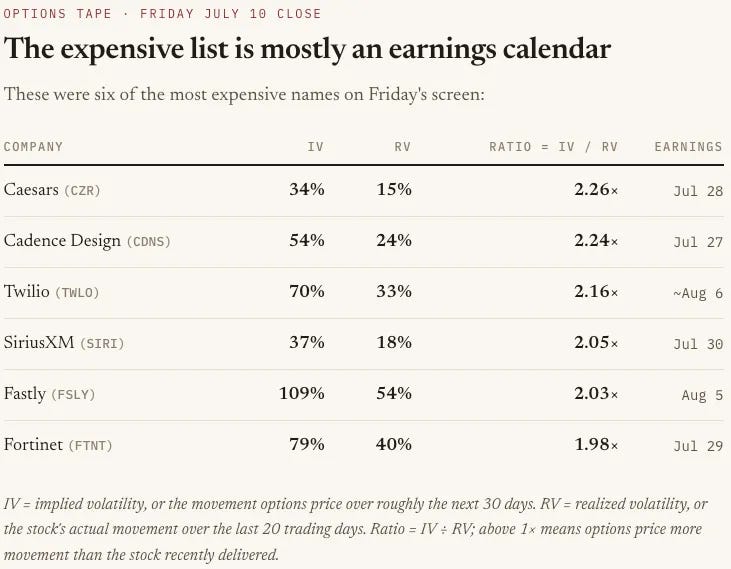
The last column explains most of the table.
Of the twelve most expensive names, ten have earnings scheduled within the roughly 30 days covered by these options. A few dates are exchange estimates; I could not verify dates for the other two small companies.
Caesars’ options price more than twice the movement the stock recently delivered. That sounds like fear, but Caesars reports July 28. One report can move the stock sharply, so sellers charge more beforehand. The same explanation applies across most of the list. These options are expensive for a reason—and selling them means accepting the earnings risk.
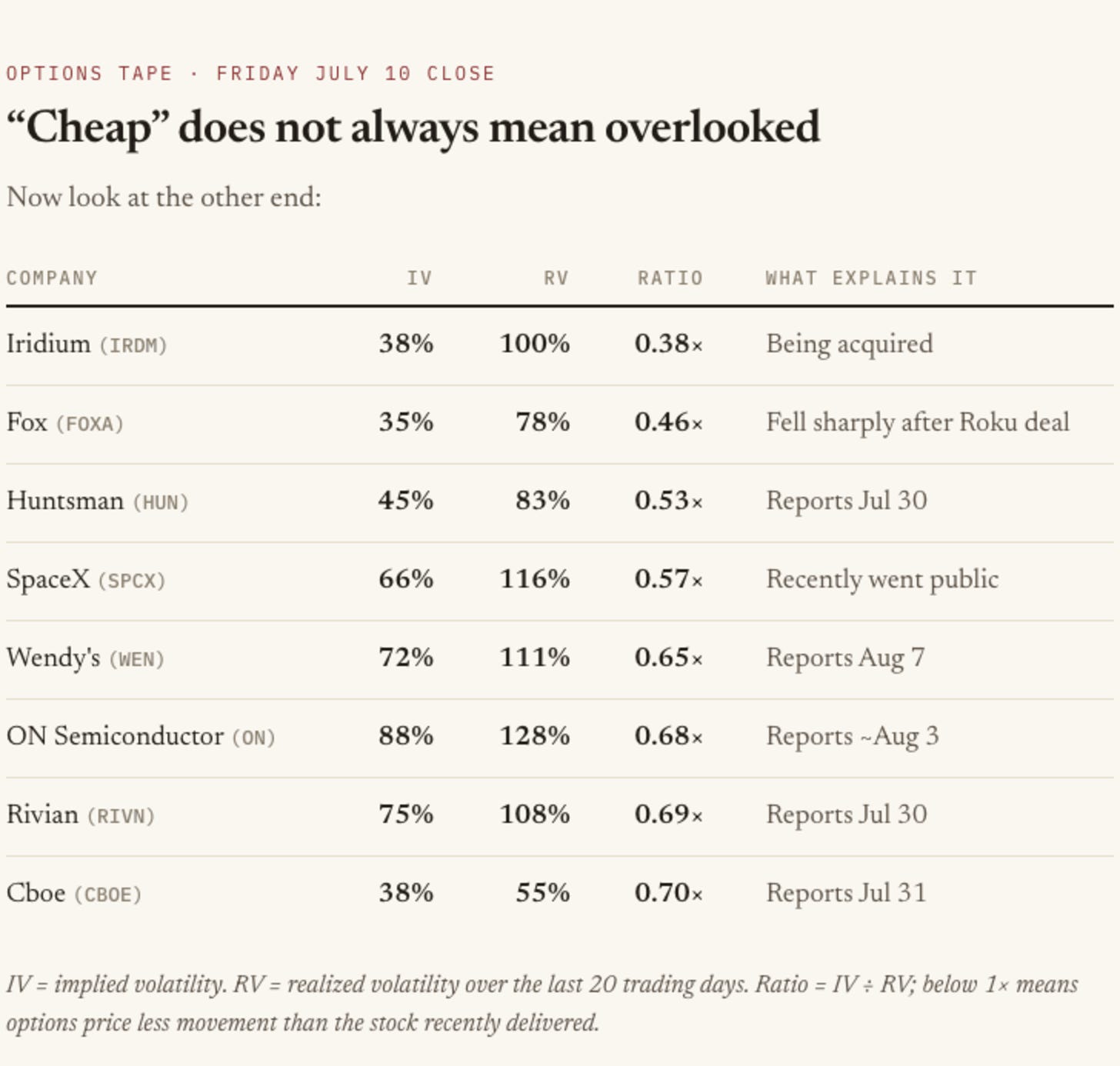
These options look cheap because the stocks recently moved more than their options now predict. But the biggest discounts have simple explanations.
Rocket Lab agreed in late June to acquire Iridium in a cash-and-stock deal valued at roughly $8 billion. The announcement pushed Iridium’s recent-volatility number higher. Its options now focus more on whether the deal closes than on how the standalone company traded.
Fox fell about 16% in one day in mid-June after agreeing to buy Roku at a valuation of roughly $22 billion—its worst day on record. That drop remains in the calculation, making today’s options look cheap by comparison.
SpaceX has traded publicly only since June 12. Its short history is dominated by IPO moves. In all three cases, the screen compares the next month with an unusual previous month. A low ratio is not automatically an opportunity.
The five names worth a second look
After removing Iridium, Fox and SpaceX, five names remain: Huntsman, Wendy’s, ON Semiconductor, Rivian and Cboe.
All five report within the period covered by their options, and all recently moved more than their options now price. That makes them worth researching, not automatically cheap. I would first ask what caused each stock’s recent movement and whether it can repeat.
Cboe is the neatest oddity. The exchange behind some of the market’s best-known volatility products has options pricing 30% less movement than its stock recently delivered. It reports July 31. Even the company that sells fear looks calm on this screen.
Three questions to ask
Before trusting any list of “expensive” or “cheap” options, ask:
Is there an event ahead? Earnings or another scheduled event can explain why options are expensive.
Did a large move already happen? A takeover, crash or IPO can make options look cheap because the comparison starts from an unusual month.
Is there still no clear explanation? That is when the screen has found something worth investigating further.
This week, expensive names mostly have earnings ahead; the deepest discounts have a large move behind them. The five names left are not trade ideas yet. They are the homework list.
Disclaimer: The Titanic was called unsinkable, too. This is research, not financial advice or a recommendation. I may be wrong, the crowd may be wrong, and confidence is not a lifeboat. Do your own research.